
The global obesity situation is more serious. According to statistics, the number of overweight/obese adults in the world will reach 2.2 billion in 2020, and it is expected to increase to 3.3 billion in 2035, accounting for 54% of the global adult population. The global economic cost of diseases associated with high body mass index (BMI) is expected to exceed $4 trillion in 2035. In China, the proportion of obese patients is expected to rise to 65.3 per cent by 2030, with 70.7 per cent of overweight patients suffering from at least one complication. Although glucagon-like peptide -1 receptor agonist (GLP-1RA) has a good effect on weight loss, its clinical application is still limited by gastrointestinal adverse reactions such as nausea and vomiting, which affects long-term compliance.
In this context, a new generation of biased GLP-1RA-Enoglutide, came into being. The drug works by selectively activating the metabolically beneficial cAMP signaling pathway while reducing the recruitment of beta-arbitin, improving treatment tolerance while achieving strong weight loss. This breakthrough is a model for the successful translation of the 2012 Nobel Prize in Chemistry-G protein-coupled receptors into clinical benefits.
Basic information
chinese Name: Enog Glutide
english name: Ecnoglutide
company No.: GT-L016
CAS No.: 2459531-73-6
sequence: His-Val-Glu-Gly-Thr-Phe-Thr-Ser-Asp-Val-Ser-Ser-Tyr-Leu-Glu-Glu-Gln-Ala-Ala-Arg-Glu-Phe-Ile-Lys (plus)-Trp-Leu-Val-Arg-Gly-Arg-Gly
molecular formula: C194H304N48O61
molecular weight: 4284.76
take a look at the mechanisms and clinical data of the "new generation" of GLP-1RA drugs.
Innovative Mechanism Kernel cAMP Biased Activation Decoupling Efficacy and Side Effects
the core improvement in the development of Enoglutide lies in its cAMP-biased signaling pathway activation mechanism, allowing the drug to achieve "Strong efficacy, good safety 」 the double benefit is also the key to becoming a new generation of GLP-1RA representatives.
In vitro studies have shown that its potency in inducing the cAMP signaling pathway is comparable to that of traditional GLP-1RA, but its β-inhibitin recruitment maximal activity is reduced by about 40% and receptor internalization activity is reduced by> 99%. Thus changing the relative proportions of the cAMP and β-arbitin signaling pathways, the mechanism of action has the following advantages:
better receptor signaling: more potent activation of the cAMP pathway and less recruitment of β-arbitins, Stronger binding affinity to GLP-1 receptors allows the drug to remain on the cell surface for a longer time, thus bringing stronger signaling, resulting in longer-lasting and stronger hypoglycemic and weight loss effects.
Retention of core pharmacological activity: the bias does not affect the receptor binding affinity, but the binding affinity of partially biased agonists to human GLP-1 receptors is significantly higher than that of non-biased similar drugs.
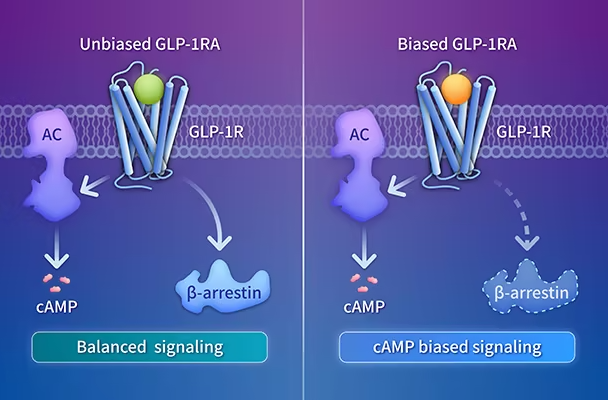
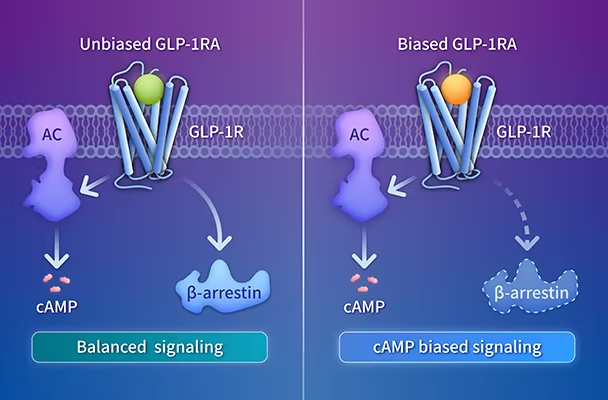
mechanism of action
by decoupling the two downstream pathways, Enoglutide achieves the dual optimization of strong weight loss and high tolerance at the molecular level, which lays a theoretical foundation for a new generation of obesity treatment drugs.
Validated clinical evidence: Enoglutide combines high efficiency, long-acting and multidimensional metabolic benefits.
The pivotal phase III study of enoglutide-SLIMMER study (multicenter, randomized, double-blind, placebo-controlled design, full analysis set n = 664) systematically evaluated the weight loss, patient response characteristics, and weight maintenance after discontinuation of enoglutide 2.4 mg.
The primary endpoint was the percentage change in body weight and the proportion of patients with ≥ 5% weight loss at 40 weeks;
the secondary endpoints are the absolute and/or percentage changes of body weight, waist circumference, BMI at 48 weeks, and the proportion of body weight loss ≥ 5%, ≥ 10%, ≥ 15%, ≥ 20%; Changes in cardiovascular metabolic indicators such as glucose and lipid metabolism, liver function, and blood pressure; Patient quality of life score; Exploratory endpoints are changes in liver fat content and uric acid levels in subjects with baseline liver fat content ≥ 8%.
Specific research results are as follows:
efficient weight loss: 90% of patients achieve clinically significant weight loss, the efficacy of the international first-line level.
Treatment with enoglutide 2.4 mg for 48 weeks achieved a mean weight loss of 15.4 (15.1% after placebo adjustment). This data verifies the advantages of its "bias" mechanism in weight loss.
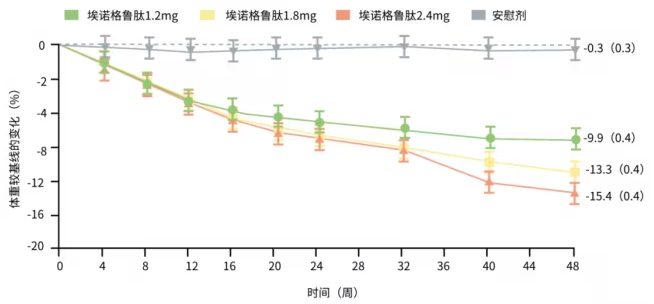
Percentage change in body weight over time
after 48 weeks of treatment, 93% of patients in the enoglutide 2.4 mg group achieved weight loss ≥ 5%,80% achieved weight loss ≥ 10%, and 64% achieved weight loss ≥ 15%. The high response rate means that whether the patient's treatment goal is to improve metabolism, alleviate comorbidities or pursue significant body size changes, enoglutide can help achieve this.
Long-term control: limited weight rebound after discontinuation, reflecting durable regulation
the study showed that patients continued to lose weight throughout the 48-week treatment period without a plateau. At follow-up after 7 weeks of discontinuation, only 1.25 percent of the body weight was regained in the enoglutide 2.4 mg group (approximately 1.1kg, baseline weight estimate).
Integrated Benefits: Simultaneous Multidimensional Metabolic Benefits
in addition to weight loss, SLIMMER study also showed that in subjects with baseline liver fat content ≥ 8%, liver fat content (magnetic resonance proton density fat fraction, MRI-PDFF) decreased by 53.1 at week 40 in the Enoglutide 2.4 mg group ( P<0.05), serum uric acid decreased by 52.7 mol/L. These metabolic benefits suggest that the effect of ernoglutide goes beyond weight numbers and strikes directly at the core pathophysiological mechanism of obesity-metabolic disorders.
The above data show that Enoglutide can not only achieve the effect of "high efficiency and high response, it also promotes the upgrading of treatment goals from "weight numbers" to "metabolic health.
Good Tolerability and Safety: Reduced gastrointestinal adverse effects and improved long-term compliance
while maintaining high efficiency of weight loss, Enoglumin showed good gastrointestinal tolerance characteristics, which reflected in the intensity of adverse events, time course and the ability of patients to maintain treatment. SLIMMER study data showed that during 48 weeks of treatment in the enoglutide 2.4 mg group, the vast majority of gastrointestinal adverse events were mild to moderate and resolved with prolonged administration..
A favorable safety profile is translating into tangible patient benefit. In SLIMMER studies, the rate of drug withdrawal due to adverse events was only 2.0 percent and the rate of treatment interruption due to gastrointestinal AE was only 0.6 percent in the Enoglutide group, which helps patients with long-term treatment.[5].
In addition, patients in the 1.8 mg and 2.4 mg groups quality of life scale (IWQOL-Lite-CT, SF-36) in physical function, mental health dimensions were significantly improved compared with the placebo group. This suggests that low withdrawal rates and high symptom tolerance together shape a sustainable weight management pathway that directly responds to the clinical pain point of "easy to start and difficult to maintain" in obesity treatment.
As the cAMP-biased design concept moves from proof-of-concept to clinical demonstration, Enoglutide is expected to establish a new paradigm of "efficacy-tolerance rebalancing" for GLP-1RA drugs.
Summary
in summary, as a new generation of cAMP-biased GLP-1RA, Enog-lutide showed excellent clinical benefits with a strong weight loss of 15.1%, a high response rate of 93%, a low rebound rate of 1.25%, good gastrointestinal tolerance and no plateau period during 48 weeks of treatment. On March 6, 2026, the drug was officially approved for long-term weight management in adult overweight/obese patients on the basis of controlled diet and increased physical activity.
Its good weight loss effect, "short, mild" adverse reaction characteristics, help to truly achieve efficient, safe and controllable, sustainable obesity management.
Post time: 2026-09-10