
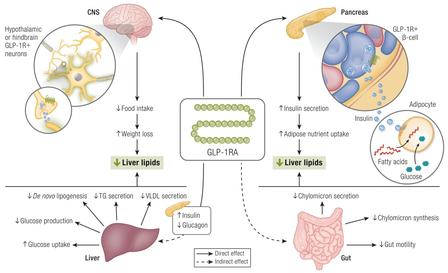
Metabolism associated fatty liver disease (MAFLD, formerly known as NAFLD) includes simple liver steatosis, non-alcoholic steatohepatitis NASH, liver fibrosis, liver cirrhosis progressive course. A large number of preclinical animal experiments and human clinical trials around the world have proved that various GLP-1 receptor agonists (GLP-1RA) can reduce liver fat content, alleviate liver inflammation, and delay the process of collagen fibrosis. However, due to the lack of GLP-1 receptors in liver cells, peptides cannot directly act on the liver, and all rely on the synergy of four independent indirect pathways of central nervous system, pancreas, intestinal tract and vascular immunity. Each pathway can independently exert the hepatoprotective effect, and part of the effect does not depend on weight loss. The first pathway: the central nervous system regulation pathway (weight loss and lipid reduction core main line) hypothalamus and hindbrain neurons express a large number of GLP-1 receptors. After GLP polypeptide injection, the drug binds to the receptor through the blood-brain barrier with blood circulation, double inhibiting appetite and gastric emptying speed, and reducing calorie and fat intake from the source. Clinical data confirm that a steady decrease of 5% in body weight can significantly reduce liver triglycerides; weight loss of more than 10% can significantly improve hepatocyte ballooning and lobular inflammation. In addition, the central GLP-1 signal can regulate intestinal lipid metabolism through the vagus nerve, and inhibit the synthesis and secretion of chylomicron in intestinal epithelial cells. Chylomicron is the main carrier of human postprandial transport of exogenous fat into the liver. GLP polypeptide can significantly reduce the level of ApoB48 (intestinal lipoprotein marker) in the blood and reduce the continuous transport of exogenous lipids to the liver. This pathway does not depend on insulin changes and can achieve lipid-lowering effect alone. The second pathway: pancreatic hormone balance pathway, improve systemic insulin resistance GLP polypeptide acts on islet beta cells to promote insulin secretion, while inhibiting the release of glucagon from alpha cells, and correcting the prevalence of insulin resistance in obese and fatty liver patients. After insulin rises, it will preferentially drive the adipose tissue to take up glucose and free fatty acids in the blood, store fat in subcutaneous fat, and avoid a large amount of lipid from flowing into the liver to synthesize triglycerides. At the same time, hormone balance can double inhibit liver lipid synthesis: on the one hand, it can down-regulate Srebpf1 and Fasn, the key genes of liver lipid synthesis, and block liver from de novo lipogenesis; On the other hand, it reduces the secretion of liver very low density lipoprotein VLDL, reduces the vicious circle of liver endogenous lipid outward circulation, continuously aggravates fat infiltration, and reduces fat accumulation from the inside of the liver. The third pathway: anti-inflammatory pathway of vascular endothelial and intrahepatic immune cells (independent of weight loss) This pathway is a major breakthrough in the study of GLP liver disease mechanism in recent years, and it is also the key to alleviate hepatitis and fibrosis without weight loss. The study found that there are functional GLP-1 receptors in liver sinusoidal endothelial cells and intrahepatic γδT cells; after specific knockout of mouse endothelial and hematopoietic cell GLP-1 genes, the anti-inflammatory and anti-fibrosis effects of polypeptides such as selmegraglutide are directly and significantly weakened. Even if the weight loss of the two groups of mice is exactly the same, the liver injury index of the experimental group is still significantly higher. After binding to endothelial and immune cell receptors, peptides can down-regulate pro-inflammatory factors such as TNF-α, IL-6, CCL2, and reduce hepatic macrophage infiltration. At the same time, it inhibits the activation of hepatic stellate cells, reduces the synthesis of fibrotic matrix such as collagen and fibronectin, and delays or even blocks the progression of fatty liver to fibrosis and cirrhosis. Fourth pathway: intestinal epithelial lymphocyte regulation pathway, alleviate systemic low-grade inflammation intestinal intraepithelial lymphocytes (IEL) is the highest expression of systemic GLP-1 receptor immune cells. After GLP polypeptide acts on intestinal immune cells, it can repair the damaged intestinal barrier, reduce the leakage of intestinal endotoxin and inflammatory factors into the blood circulation, and reduce the systemic chronic low-grade inflammation. Systemic inflammation is an important incentive to aggravate liver lipotoxicity and liver cell injury. Stable intestinal immune microenvironment can indirectly and continuously reduce chronic liver injury, and form the intestinal-liver metabolic protection axis. The four pathways work together to achieve the comprehensive liver protection effect of GLP polypeptide in reducing liver fat, anti-inflammatory and anti-fibrosis, which is also the core mechanism research direction of modeling and new drug screening in major laboratories. Page Break## Article 3 Clinical Interpretation | Summary of Complete Clinical Data of Mainstream GLP Polypeptide Therapy for NASH [Column: Medical Research and Development Reference | Matching Chart: No Special Clinical Chart, Insertable Clinical Trial Flow Chart] Nonalcoholic Steatohepatitis (NASH) is a key stage in the progression of fatty liver disease, with triple characteristics of liver fat accumulation, inflammation and liver cell damage. It will irreversibly develop into liver fibrosis, cirrhosis and liver cancer for a long time, at the same time, the risk of cardiovascular diseases such as myocardial infarction and cerebral infarction is greatly increased. For a long time, there has been no specially approved NASH treatment specific drug in the world, and a number of GLP-1 series of polypeptides after II, III large-scale human clinical trials, fully verified the efficacy of liver protection, different target polypeptides clinical manifestations there are obvious differences, the following summary of the market mainstream polypeptide complete clinical data. 1. Simaglutide (long-acting single-target GLP-1 polypeptide) Simaglutide is currently the only GLP polypeptide in the world with complete clinical data for NASH indication Phase III. In the 72-week core trial, 0.1mg, 0.2mg and 0.4mg were given daily in three groups, and the complete regression rate of NASH in placebo control group was only 17%. The NASH regression rate of subjects in the high dose 0.4mg group reached 59%, liver triglyceride, ALT and AST liver enzymes decreased significantly in a dose-dependent manner, and their body weight decreased by an average of 13%. Phase II trials in people with compensated cirrhosis NASH showed that 2.4mg of selmegraglutide per week only reduced blood lipids and liver enzymes, but did not achieve resolution of NASH inflammation and improvement of fibrosis. At present, ESSENCE large-scale phase III clinical trial (NCT04822181) is being carried out worldwide, including 1200 non-cirrhotic NASH patients, long-term follow-up to evaluate liver hard end points and cardiovascular events, and follow-up data will directly define the clinical positioning of long-acting GLP polypeptides in the field of NASH. 2. Liraglutide (once-daily single-target GLP-1 polypeptide) The classic LEAN Phase II clinical trial was the core basis for Liraglutide liver disease, and 23 biopsy-confirmed NASH patients were dosed with 1.8mg daily for 48 weeks. The final results showed that only 9% of the subjects in the treatment group had fibrosis progression, compared with 36% in the placebo control group. 39% of the patients achieved complete resolution of NASH and no deterioration of fibrosis. Liraglutide weight loss is weaker than Smeglutide, liver fat improvement effect is slightly lower, more used for early fatty liver basic scientific research, animal model experiments, the corresponding polypeptide raw material procurement needs concentrated in the university laboratory, CRO company. 3. Tilpotide (GLP-1/GIP double-target co-agonist polypeptide) Tilpotide is a weekly double-target polypeptide, which activates both GLP-1 and GIP metabolic pathways at the same time. SURPASS series of diabetic subgroups MRI liver tests show that the drug can significantly reduce liver fat and visceral fat content. The phase II clinical (NCT04166773) data specifically for NASH population are bright: 62.4 percent of the subjects in the high dose group have achieved NASH regression, more than half of the patients have improved liver fibrosis grade by at least one phase, and the comprehensive effects of lipid-lowering, weight loss and anti-inflammatory are better than those of single-target GLP, which is the polypeptide raw material with the fastest growth in the clinical stage of innovative pharmaceutical enterprises. 4. Dupeptide (GLP-1/GCG double target polypeptide) is different from GIP double agonist, which can additionally activate glucagon receptor, directly improve the fatty acid oxidation efficiency of liver mitochondria, and make up for the deficiency of single target GLP anti-fibrosis ability. The 54-week human phase IIb test showed that the decrease of ALT and AST in the 300μg daily dose group was significantly higher than that in the same dose of liraglutide. In the high-fat-induced NASH mouse model, domotide can simultaneously reduce hepatic triglyceride, inflammatory factors and collagen deposition, which is more suitable for pipeline development of people with severe liver fibrosis. Comprehensive all clinical trials unified short board: simple single-target GLP polypeptide on moderate and severe liver fibrosis reversal effect is limited, can only delay progress.
Post time: 2026-08-11