
Vitiligo is a globally prevalent acquired skin disorder characterized by localized or generalized depigmentation, primarily due to the destruction of melanocytes in the skin, leading to white patches. For a long time, existing treatments have struggled to fundamentally restore melanocytes or improve the skin microenvironment, making vitiligo a significant challenge in the medical field.
On November 23, 2021, a research team led by Professor Du Yongzhong from the School of Pharmacy at Zhejiang University published a novel biomimetic multicolor synergistic treatment strategy for vitiligo, centered on the KPV tripeptide, in the international top-tier journal ACS Nano, opening up new perspectives for the safe and effective treatment of vitiligo.
The core pathogenesis of vitiligo lies in the inflammatory cascade triggered by reactive oxygen species (ROS). Oxidative stress not only damages the survival environment of melanocytes but also directly impairs melanocytes and hinders melanin synthesis. The key component of this treatment is the effective fragment of melanocyte-stimulating hormone—the KPV tripeptide. As an active fragment of α-melanocyte-stimulating hormone (α-MSH), the KPV tripeptide retains excellent pharmacological activity while avoiding the potential pigmentation side effects of its parent molecule.
The research team innovatively designed a liposomal system co-loaded with polydopamine (PDA) modified by the KPV tripeptide and methylprednisolone (MPS), establishing an efficient nanoscale transdermal co-delivery system. The liposomes themselves possess excellent transdermal permeability, while the surface-modified KPV tripeptide specifically binds to melanocytes, enabling the nanoscale formulation to precisely anchor at the lesion site. This significantly enhances drug retention and accumulation in the basal layer of the skin. After drug release, the residual KPV tripeptide continues to function, promoting melanocyte proliferation and enhancing melanosome production and transport capacity, achieving long-term stable repigmentation effects.
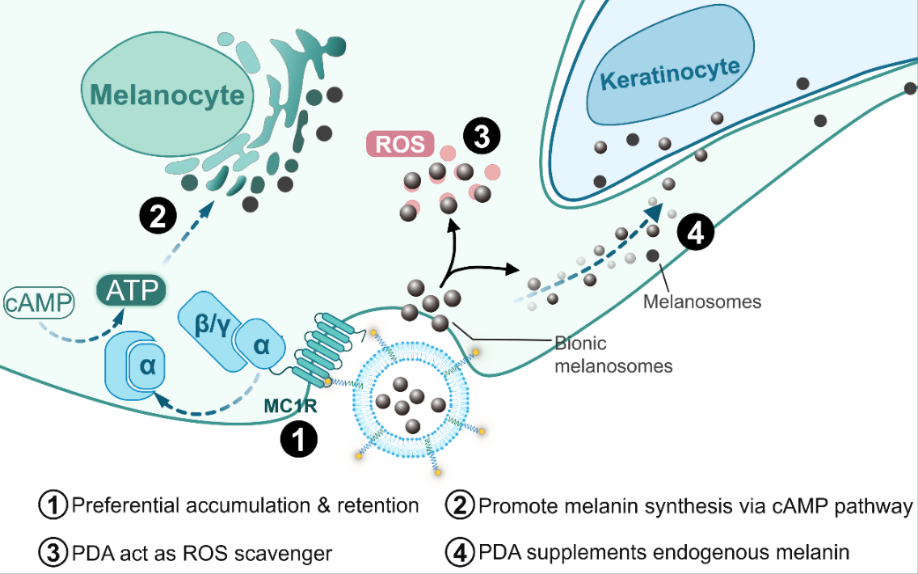
This study was thoroughly validated in a H₂O₂-induced vitiligo mouse model. The results showed that after treatment with the KPV tripeptide-modified nanodrug formulation, the levels of inflammatory factors in the lesion sites of the mice significantly decreased, reactive oxygen species were effectively cleared, and the originally pale white patches gradually regained normal skin pigmentation. The proliferative activity of melanocytes was markedly enhanced, and the quantity and distribution of melanosomes within keratinocytes also improved significantly.
Currently, this research has been published online in the top-tier international journal ACS Nano, drawing widespread attention from the academic community. With further advancements in subsequent studies, it is believed that these nanomedications, centered on the KPV tripeptide, may eventually be developed into clinical drugs, bringing hope to countless vitiligo patients worldwide!
Post time: 2025-12-01