
Keyword:NAD+,53-84-9,NAD+ Bioactive Peptide
NAD+, the abbreviation of Nicotinamide Adenine Dinucleotide, is a vital coenzyme that exists in all living cells of the human body, and is also the core molecule connecting cell metabolism, DNA repair, aging regulation and disease occurrence. Since its discovery in 1904, NAD+ has been confirmed to participate in more than 500 kinds of enzymatic reactions in the body, and is indispensable for maintaining normal life activities. It is not only a key electron carrier in the process of energy metabolism, but also an essential substrate for activating important proteins such as Sirtuins and PARPs, which determines the energy supply, repair ability and aging speed of cells. With the deepening of research, NAD+ has become a hot spot in the fields of anti-aging, metabolic disease treatment and neuroprotection, and its level change is regarded as an important biomarker of body aging and health status.
The Chemical Structure and Basic Forms of NAD+
NAD+ is a small molecule composed of two nucleotides, namely nicotinamide mononucleotide (NMN) and adenine dinucleotide, and its structure contains nicotinamide (a derivative of vitamin B3), adenine, ribose and phosphate groups. It mainly exists in two interconvertible forms in cells: oxidized NAD+ and reduced NADH. NAD+ is in an "empty" state and can accept electrons generated during metabolic reactions, while NADH is in a "full" state carrying electrons, which can release electrons in the mitochondrial respiratory chain to promote ATP synthesis. The cycle conversion between NAD+ and NADH (NAD+ ↔ NADH) is the core of cell energy production, and the ratio of NAD+/NADH directly affects the efficiency of energy metabolism and the redox state of cellsPMC. In addition, NAD+ can be phosphorylated to form NADP+, and its reduced form NADPH is mainly used for anti-oxidative stress and anabolic reactions requiring reducing power, jointly maintaining the balance of cell redox.
NAD+ is the Core Driver of Cellular Energy Metabolism
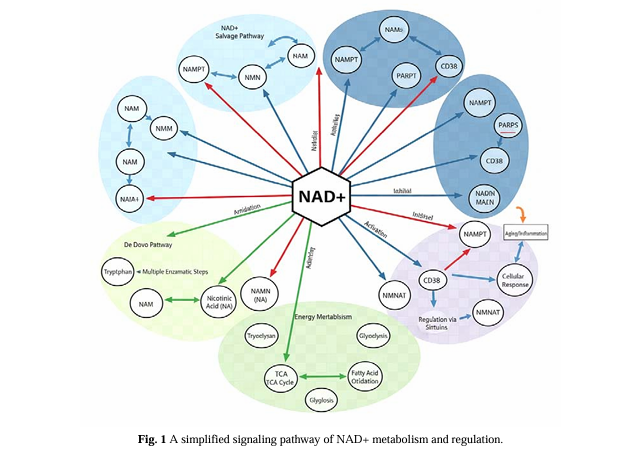
The most basic function of NAD+ is to serve as a key coenzyme in cellular energy metabolism, responsible for transferring electrons in glycolysis, tricarboxylic acid cycle (TCA cycle) and fatty acid oxidation processes. When the human body digests and absorbs carbohydrates, fats and proteins, these nutrients are decomposed into small molecules and enter the mitochondria. At this time, NAD+ continuously accepts hydrogen ions and electrons removed during the decomposition process, converting to NADH. NADH then transports these high-energy electrons to the mitochondrial electron transport chain, and through a series of redox reactions, finally promotes the synthesis of ATP, the direct energy currency of cells. This process provides more than 90% of the energy required for life activities, supporting basic physiological functions such as heart beating, brain thinking, muscle contraction and cell division. Without sufficient NAD+, cells cannot convert food into energy, and all life activities will be blocked, which fully reflects the irreplaceable importance of NAD+.
NAD+ Dominates DNA Repair and Genomic Stability
DNA damage is an inevitable event in the process of cell life, and timely repair is the key to maintaining genomic stability and preventing cell mutation and aging. NAD+ plays a pivotal role in this process as an essential substrate for Poly (ADP-ribose) Polymerase (PARP). When DNA single-strand or double-strand breaks occur, PARP is rapidly activated, and consumes a large amount of NAD+ to synthesize ADP-ribose chains, which recruit and activate a variety of DNA repair proteins to complete the repair of damaged sites. At the same time, NAD+ is also a necessary cofactor for the Sirtuins protein family (including SIRT1, SIRT3, SIRT6, etc.). Sirtuins, known as "longevity proteins", rely on NAD+ to exert deacetylation activity, regulate cell cycle, inhibit cell apoptosis, enhance cell stress resistance, and further maintain the stability of chromosomes and genes. Studies have confirmed that the lack of NAD+ will lead to the decline of PARP and Sirtuins activities, resulting in the accumulation of DNA damage, accelerating cell senescence and increasing the risk of related diseases.
NAD+ Regulates Aging and Age-Related Diseases
A large number of studies have confirmed that the level of NAD+ in various tissues and organs of mammals decreases significantly with age. Harvard Medical School research shows that after the age of 25, the human body's NAD+ level drops at a rate of 12% to 15% per year; by the age of 40, it is only about 50% of that at the age of 20; by the age of 60, it drops to 20% to 30%. This progressive decline is closely related to the occurrence of aging and aging-related diseases. Low NAD+ levels lead to weakened mitochondrial function, reduced energy production, increased oxidative stress, and impaired DNA repair capacity, which in turn trigger a range of aging manifestations such as fatigue, memory loss, skin relaxation, and metabolic disorders. In addition, the decline of NAD+ is also associated with the pathogenesis of many chronic diseases, including type 2 diabetes, cardiovascular disease, neurodegenerative diseases (Alzheimer's disease, Parkinson's disease), and muscle atrophy. A study published in Nature Aging (2025) pointed out that restoring NAD+ levels can improve mitochondrial function, protect neurons, and delay the progression of age-related diseases. Another study in Cell Metabolism (2020) confirmed that NAD+ precursor supplementation can reverse aging-related muscle atrophy and enhance physical endurance.
Biosynthesis Pathways and Supplementation Strategies of NAD+
The human body mainly synthesizes NAD+ through two pathways: de novo synthesis pathway and salvage pathwayPMC. The de novo synthesis pathway starts from tryptophan and is completed through multiple enzymatic reactions, with low efficiencyPMC. The salvage pathway is the main way for the body to generate NAD+, which uses nicotinamide (NAM), nicotinamide riboside (NR), nicotinamide mononucleotide (NMN) and other precursors to synthesize NAD+ through a series of reactions, among which Nicotinamide Phosphoribosyltransferase (NAMPT) is the rate-limiting enzymePMC. With age, the activity of NAMPT decreases and the decomposition of NAD+ (mainly mediated by CD38 enzyme) increases, leading to the continuous decline of NAD+ levelsPMC. At present, the main ways to increase NAD+ levels in the body include supplementing NAD+ precursors (such as NMN, NR), inhibiting CD38 enzyme activity, and enhancing NAMPT activity. Among them, NMN and NR, as direct precursors of NAD+, can be efficiently converted into NAD+ after entering cells, and have become the most researched and applied nutritional supplement ingredients. Clinical studies have shown that reasonable supplementation of NAD+ precursors can effectively increase the body's NAD+ level, improve energy metabolism, enhance exercise capacity, improve sleep quality, and alleviate cognitive decline.
Conclusion
In summary, NAD+ (Nicotinamide Adenine Dinucleotide) is a core coenzyme that sustains life activities, integrating energy metabolism, DNA repair, aging regulation and disease defense. It is not only the "power engine" of cells, responsible for converting food into energy, but also the "repairman" of genes, maintaining the stability of the genome; it is also a "regulator" of aging, and its level changes directly determine the speed of cell senescence and the health status of the body. The decline of NAD+ level is an important cause of aging and chronic diseases, and reasonably restoring NAD+ level has become a key strategy to promote healthy aging and prevent related diseases. With the continuous breakthrough of scientific research, NAD+ will play a greater role in the fields of health care and clinical medicine, bringing new hope for human health and longevity.
Post time: 2026-04-16