
RGDfK cyclic peptide is a specific ligand for integrin αvβ3 receptor, and its synthesis usually adopts the strategy of solid phase peptide synthesis (SPPS) combined with liquid phase cyclization. The typical synthetic pathway consists of four main stages: linear peptide chain assembly, side chain deprotection, intramolecular cyclization, and final purification. The protection strategy based on Fmoc chemistry has become the mainstream synthesis method because of its mild reaction conditions and efficient deprotection characteristics. The entire synthesis process needs to be carried out under strict control of reaction temperature, pH and solvent system to ensure the purity and biological activity of the final product.
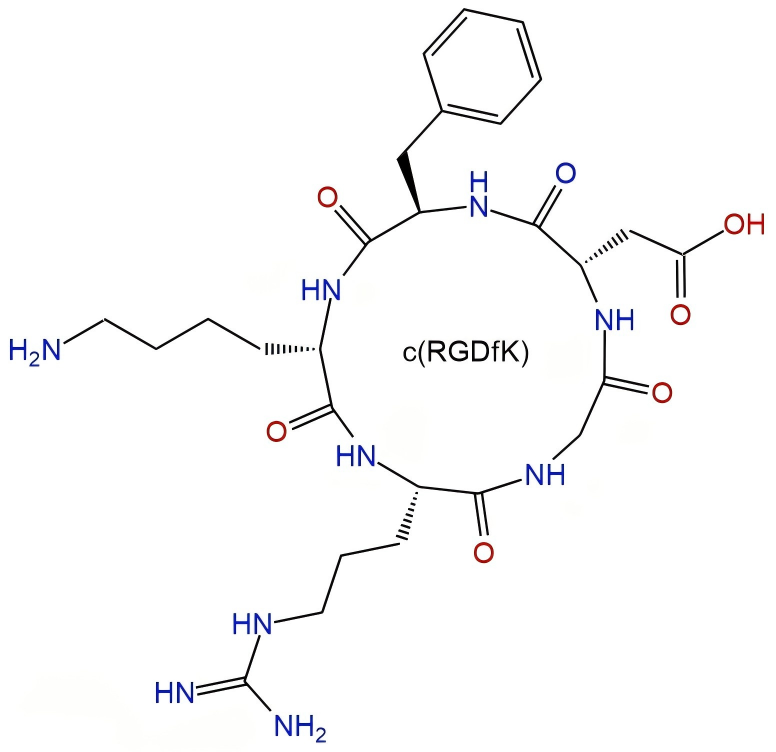
Chemical structural formula of cyclic peptide RGDfK
basic information
chinese name: Cyclic peptide RGDfK
english name: c(RGDfK)
company No.: GT-H005
CAS No.: 161552-03-0
sequence: cyclo (Arg-Gly-Asp-d-Phe-Lys)
molecular formula: C27H41N9O7
molecular weight: 603.67
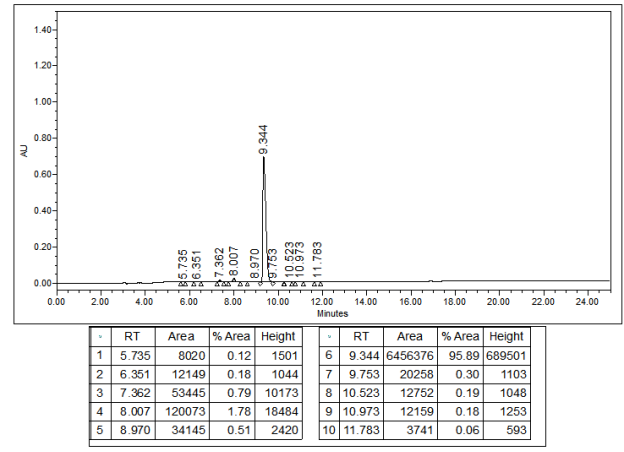
HPLC profile of cyclic peptide RGDfK
solid phase synthesis of linear peptide chains
the construction of the linear peptide chain begins with the pretreatment of Wang resin. 0.1 mmol of Wang resin was placed in a polyethylene polypeptide synthesis vessel and washed sequentially with DMF, DCM, and IPA 4 times for 1 minute each, followed by swelling in DCM for 1 hour. The first amino acid Fmoc-Leu was coupled using a pre-activation strategy: 234 mg of Fmoc-Leu(4 eq) was activated with 57 μL of DCC(4 eq), 54 μL of pyridine (6 eq) in anhydrous DCM for 5 minutes and then added to the resin system to react overnight. The subsequent amino acid coupling was performed using standard Fmoc procedures: the Fmoc protecting group was first deprotected with 20% piperidine/DMF solution (2 x 7 min), followed by coupling of 2 equivalents of Fmoc protected amino acid with 1.95 equivalents of BOP, 2 equivalents of HOBt and 4.5 equivalents of NMM in DMF for 1-2 h after activation.
Notably, the introduction of aspartic acid (D) and phenylalanine (f) requires special handling. Aspartic acid is usually protected by the OtBu side chain, while phenylalanine needs to use the D-form configuration to enhance receptor binding specificity. The ε-amino group of lysine (K) needs to be protected with Boc for subsequent cyclization. After each step of coupling, Kaiser reagent is used to detect the completion of the reaction, and incomplete coupling needs to be repeated until the reaction is complete.

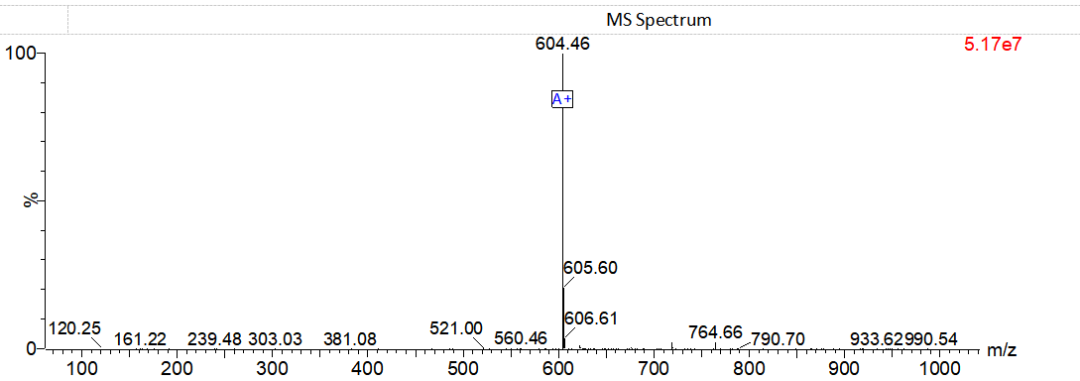
Cyclic Peptide RGDfK MS Figure
key Technology of Cyclization Reaction
after the synthesis of the linear peptide chain is completed, the successful implementation of the cyclization reaction depends on the precise control of three key steps. First, a mixture of TFA:TIPS:H₂ O(95:2.5:2.5) is used to cleave the peptide chain from the resin while removing most of the side chain protecting groups. The process requires continuous stirring for 2 hours. After cleavage was complete, the resin was washed with TFA:CH₂ Cl₂(1:9), the combined filtrates were concentrated to a volume of about 1 mL, and the crude peptide was precipitated by the addition of cold ether.
The cyclization reaction itself is usually carried out in dilute solution (concentration 0.1-0.5 mM) to suppress intermolecular side reactions. BOP(86 mg), HOBt(27 mg) and NMM(50 μL) were used as condensation reagents in DMF for 12-24 hours. The progress of the reaction can be monitored by HPLC and the reaction is considered complete when the linear precursor peak area falls below 5% of the initial value. For RGDfK sequences containing the D-form phenylalanine, cyclization yields were typically up to 60-75%, significantly higher than for the full L-form analogs.
Table 1 Comparison of the effects of different cyclization conditions on yield
| solvent | temperature (°C) | reaction time (h) | yield (%) | |
| BOP/HOBt/NMM | DMF | 25 | 24 | 68 |
| HATU/DIEA | DMF | 25 | 18 | 72 |
| PyBOP/HOAt/DIEA | DMF/CH₂Cl₂(1:1) | 15 | 36 | 65 |
| DPPA/NMM | DMF | 4 | 48 | 58 |
purification and characterization techniques
the crude product was purified by preparative reversed-phase high performance liquid chromatography (RP-HPLC) with C18 column as stationary phase and water/acetonitrile (containing 0.1%TFA) as mobile phase for gradient elution. The optimized elution procedure was an initial hold of 10% acetonitrile for 5 minutes followed by a linear increase to 60% acetonitrile over 30 minutes. The target peak was collected according to the retention time to give pure white to off-white powder after lyophilization.
The product quality control needs to be verified by a variety of analytical techniques: mass spectrometry (MS) confirms the molecular weight (theoretical value 603.67),HPLC purity analysis needs to reach more than 95%, and circular dichroism (CD) verifies the cyclic conformation characteristics. It is worth noting that the presence of D-type phenylalanine gives the product a characteristic CD negative peak around 214 nm, which is an important indicator of conformational correctness. Hydrogen nuclear magnetic resonance spectroscopy (¹ H NMR) can further confirm the correct linkage sequence and configuration of each amino acid residue.
Common Problems and Solutions
in the actual synthesis process, researchers often encounter several typical problems. Inefficient cyclization is often due to insufficient purity or high concentration of the linear precursor. It is recommended to purify the linear peptide by semi-preparative HPLC before cyclization and control the reaction concentration at about 0.2 mM. The problem of poor product solubility can be ameliorated by the addition of small amounts of acetic acid (1-5%) or DMSO(≤ 10%). The main reason for product degradation during storage is moisture absorption, which should be sub-packed and stored in a nitrogen-filled environment, and the working solution is now ready for use.
For the need for further functionalization, such as fluorescent labeling or radiochelation, modification at the ε-amino group of lysine is usually chosen. For example, in the case of CY3 labeling, the purified c(RGDfK) is reacted with the CY3-NHS ester in a sodium bicarbonate buffer at pH 7.4-8.0 for 4 hours to obtain the labeled product. A similar strategy is also applicable to the preparation of DOTA chelates to provide targeted probes for nuclear medicine imaging.
Application-Oriented Derivatization Synthesis
based on the basic RGDfK cyclic peptide structure, a variety of functional derivatives have been developed. The synthesis of PAE-PEG-c(RGDfK) copolymer adopts a three-step method: the PAE backbone is first prepared by Michael addition, then coupled with PEG segments, and finally grafted with c(RGDfK) at the end. This structure significantly improves the tumor targeting and in vivo circulation time of the drug.
The synthesis of another important variant DOTA-c(RGDfK) requires the completion of linear sequence assembly on the resin, the removal of allyl protection at the C- terminal with Pd(PPh), and then intramolecular cyclization. The purified cyclic peptide is reacted with a DOTA-NHS ester under slightly basic conditions to give a precursor compound useful for radionuclide labeling. Such derivatives exhibit excellent tumor targeting properties in PET imaging.
With the development of precision medicine, the synthesis technology of RGDfK cyclic peptide and its derivatives will continue to be optimized. The introduction of a microfluidic synthesis platform is expected to improve batch-to-batch consistency, while computational-assisted sequence design will further enhance its receptor affinity. These advances will promote the wider application of these molecules in the integration of cancer diagnosis and treatment.
Post time: 2026-08-26