
Overview
acetyl tetrapeptide -9 is a synthetic peptide substance composed of four amino acid residues (glutamic acid, aspartic acid, valine, histidine), which appears as a white powder at room temperature. The N-terminal of the substance is modified by acetylation. This structure gives it good stability and skin penetration. In addition, the substance can also activate dermal fibroblasts, increase the secretion of collagen and elastin, and improve skin firmness. It has a targeted effect on the relaxation of fragile areas such as eyes.
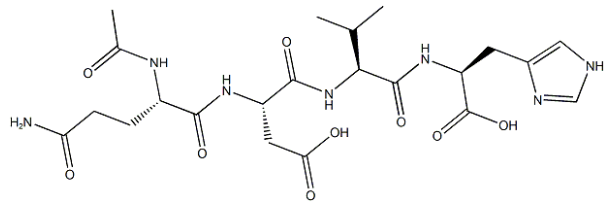
Chemical structural formula of acetyl tetrapeptide -9
with its increasingly widespread application in skin care products, efficient, economical and environmentally friendly synthesis and purification methods have become the focus of research in related fields. Although the traditional liquid phase peptide synthesis method can be used for fragment condensation, the steps are cumbersome and the total yield is low, which is difficult to meet the needs of industrialization. Moreover, it is difficult to achieve high resolution and high recovery rate at the same time in a single chromatographic separation. This paper provides a method for synthesizing acetyl tetrapeptide -9, which improves separation efficiency, resolution, and product purity and yield.
Basic information
chinese Name: Acetyl Tetrapeptide -9
english name: Acetyl Tetrapeptide-9
G Company No.: GT-C046
CAS No.: 928006-50-2
sequence: Ac-Gln-Asp-Val-His-OH
molecular formula: C22H33N7O9
molecular weight: 539.54
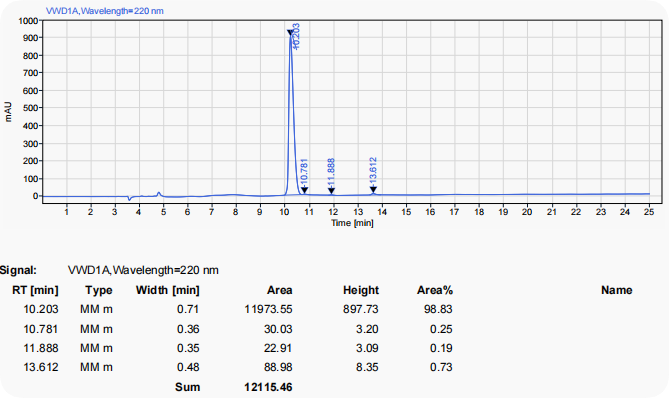
acetyl tetrapeptide -9 HPLC
synthetic method
1. Take a plurality of solid-phase synthetic resins, add a swelling agent to the plurality of solid-phase synthetic resins, add a condensing agent and an activating agent to dissolve and cool, the cooling temperature is -10°C, and the cooling time is 20-30 minutes; add the condensing agent to the cooled system of the solid-phase synthetic resin and the condensing agent and the activating agent to dissolve, couple for 2-5.5 hours and wash to obtain the peptide chain. To maximize the inhibition of side reactions, improve coupling efficiency, and ensure the accuracy of the final peptide chain sequence.
2. The peptide chain is cleaved and separated, comprising: transferring the peptide resin complex, which is synthesized in the preceding process, fully washed and dried, to a dedicated cleavage reactor. The lysis solution prepared in advance and cooled to a low temperature was added, and the reaction was stirred at room temperature. The reaction time is usually controlled to 2-3 hours. This mild temperature and sufficient time window ensure that the cleavage and deprotection reactions are complete, while minimizing the degradation of the peptide chain or side reactions that may be caused by the long-term action of strong acids. After cleavage, trifluoroacetic acid may be used for washing and separation to obtain the acetyl tetrapeptide -9 crude peptide product.
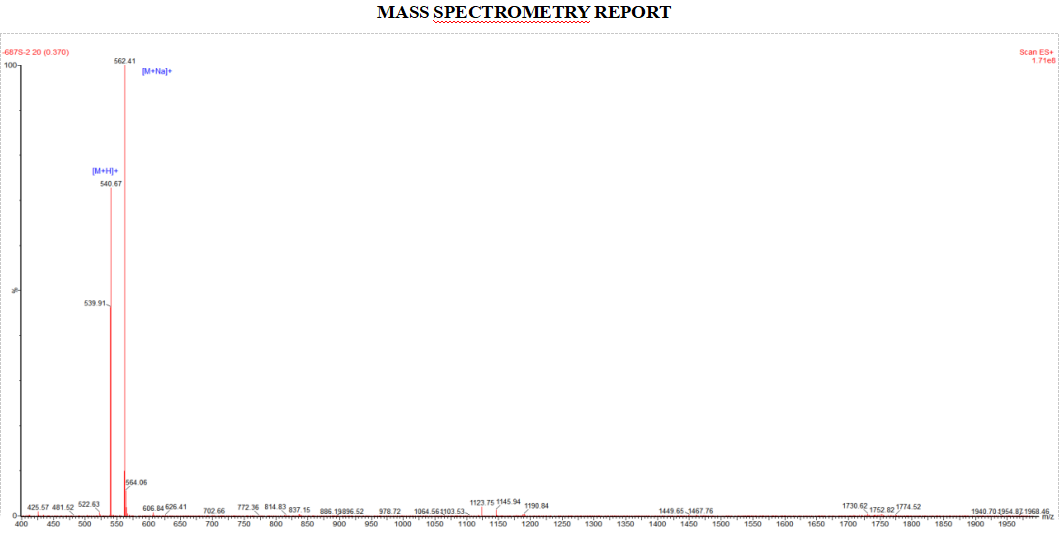
Acetyl tetrapeptide -9 MS
3. Dissolve and filter the crude target peptide with a small amount of phase A (trifluoroacetic acid aqueous solution), and then apply the sample to the first liquid chromatography column. The first liquid chromatography column may be a 300DAC dynamic column, the packing is Daiso-C18-8-100, the wavelength is 230nm, and the flow rate is 1600 mL/min. Through the first gradient elution of the first liquid chromatography column, the high-throughput, large-capacity preliminary separation is carried out, and most of the impurities with significant differences in physical and chemical properties from the target peptide are quickly removed.
4. The eluent fraction is loaded onto a second liquid chromatography column, and a second gradient transalting elution is performed using an eluent composed of phase A1 (aqueous ammonium acetate solution), phase A2 (aqueous acetic acid solution) and phase B (acetonitrile), and the refined acetyl tetrapeptide -9 is obtained after concentration and lyophilization.
Post time: 2026-10-20