
Natural peptide sequences are generally composed of 20 natural protein amino acids, which are widely used in drug delivery and disease treatment because of their low toxicity, low immunogenicity, high tissue permeability and easy synthetic modification. However, peptides are easily decomposed by a variety of proteases and have a high clearance rate, which leads to fast metabolism, poor stability and short half-life in vivo, which brings challenges to the development and application of peptide-related drugs. These problems can be ameliorated to some extent by the use of unnatural amino acids at the time of polypeptide design. For example, the introduction of a D-form amino acid changes the conformation of the polypeptide, thereby rendering the modified polypeptide less susceptible to hydrolysis by proteolytic enzymes.
Solid Biology has a rich library of unnatural amino acids, which can provide you with a wide variety of unnatural amino acid polypeptide synthesis services, including: N-methyl amino acids(N-methyl amino acids), unnatural amino acids (unnatural amino acids),acetyl-lysine (acetyl lysine), beta-alanine(β-Ala), aminobenzoic acid (para-aminobenzoic acid), Amidation (amidation), Acetylation (), Abu, citrulline (citrulline), Acm, dimethyl-Lysine (dimethyllysine), Hydroxy-proline (hydroxyproline, Hyp), methyl-Lysine (methyllysine), mercaptopropionic acid (mercaptopropionic acid), Nitro-Tyrosine (nitrotyrosine), Norleucine (norleucine, Nle),Pyro-Glutamic acid (pyroglutamic acid, Pyr), carbobenzoxyl (carbonyl, Z), succinic acid (succinic acid), sulfurylation (sulfonylation), etc.
D-amino acids
protease hydrolysis reactions are generally stereospecific. The introduction of a D-form amino acid changes the configuration of the polypeptide, thereby making the modified polypeptide less susceptible to hydrolysis by proteolytic enzymes. A useful method is to replace the amino acids at the C- and N-termini of the polypeptide chain with D-form amino acids, or to replace amino acid residues with poor peptide bond stability, or to replace all amino acids. When a polypeptide is not replaceable by a particular sequence, it can be linked to a D-form peptide to improve the protease stability of the peptide.
D-amino acid peptides have many advantages, such:
1) Some polypeptides containing D-type amino acids have more biological potential.
Omega-agatoxins, which are D-serine at position 46. Peptides IVB and IVC inhibit P-type calcium channels in Purkinje cells of rat cerebellum about 4 times more than those of L-serine isoforms. Another example is frogborphin (dermorphin), isolated from the skin of South American tree frogs. Frog-borphin is one thousand times more potent than morphine in relieving deep, long-acting analgesia. The second amino acid of this 7-peptide is D-alanine. However, the isomer with L-alanine at this position has no biological activity.
2) The D-type amino acid polypeptide is resistant to degradation by proteases.
The peptide bond formed by D-type amino acid has stronger enzyme resistance than L-type amino acid. For example, when the amino terminal of frog-piphin (dermorphin) is Tyr-D-Ala, it can resist the hydrolysis of aminopeptidase, but if it is L-type peptide, it will be rapidly degraded. The modified polypeptide will be more stable, have stronger resistance to protease hydrolysis, and still retain the same binding properties as the original L-polypeptide. Studies have shown that replacing the amino acids on both sides of some MUC2 polypeptides with D-type amino acids still exhibits its antigenic properties and enzymatic stability.
3)D-amino acids can be regarded as signal molecules.
Cholera bacteria use racemase to convert large amounts of the corresponding amino acids in the L form to D-methionine and D-leucine. This D-amino acid alerts the wall proteins of the cell, thereby slowing down the production of peptidoglycan. Most likely, this peptide isomerization is achieved by the deprotonation-protonation mechanism of alpha-carbon. This mechanism has been established for several amino acid racemases, such as proline, aspartate, glutamate racemase, and both active site cysteines are involved in this reaction. The racemase is located in the interwall space of the inner and outer membranes, and when the cell stops growing, the synthesis of D-amino acids is initiated.
Solid biological can provide you with 20 kinds of natural amino acids corresponding to all D-amino acids, including: D-Ala,D-Arg,D-Asp,D-Asn,D-Cys,D-Glu,D-Gln,D-His,D-Allo-Ile,D-Leu,D-Lys,D-Met,D-Pro,D-Phe,D-Ser,D-Tyr,D-Thr,D-Trp,D-Val.
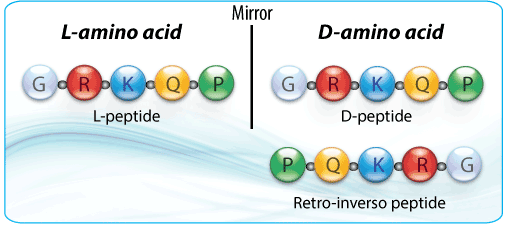
Retro-inverso polypeptide
Retro-inverso peptides are assembled from D-form amino acids in the reverse order of their native L-polypeptide sequence. retro-inverso peptides are obtained by substituting D-form amino acids for normal L-form amino acids and reversing the orientation of the main backbone of the polypeptide. The original spatial orientation of all side chains has not been altered. retro-inverso the pillars of the peptide are reversed, the chirality of the amino acids in the sequence is preserved. This will result in the formation of complementary side chain topochemical reactions between the analog and the native L-form polypeptide.
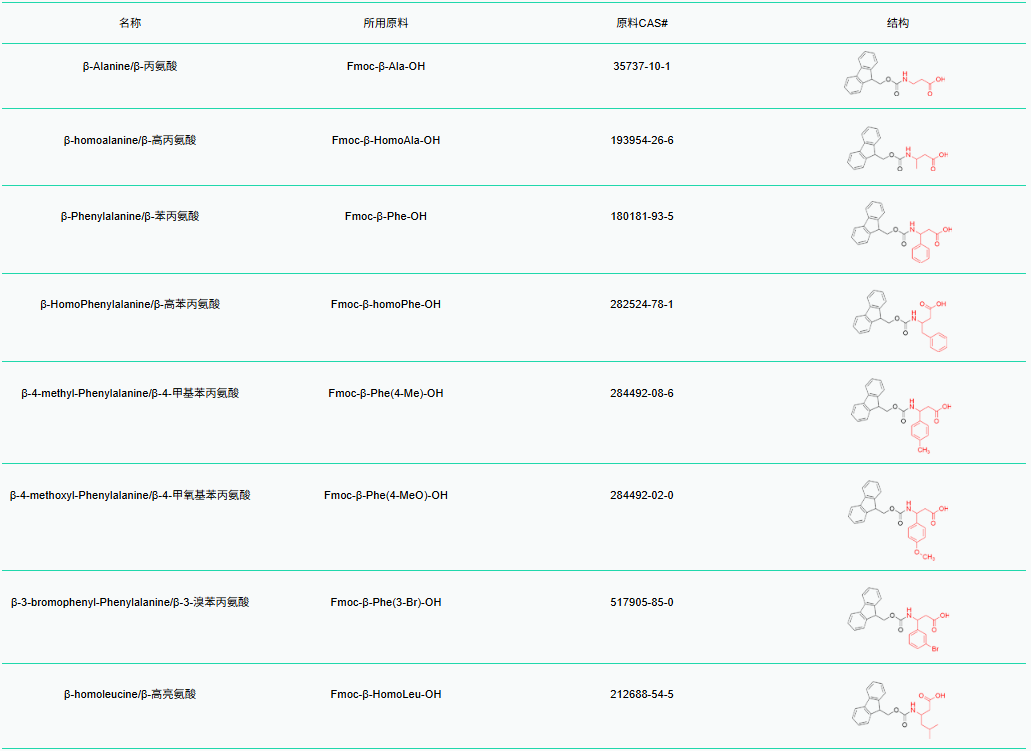
beta-amino acids
natural amino acids are generally alpha-amino acids, that is, the amino and carboxyl groups of amino acids are attached to a C atom, while beta-amino acids are amino and carboxyl groups of amino acids are attached to two C atoms. If the amino acids in the polypeptide are replaced with β-amino acids, the overall conformation of the polypeptide can be changed, and the water molecules in the original protease cleavage center cannot form hydrogen bonds with the amide bond, which is not conducive to the cleavage of the amide bond by the protease, and thus has a stronger hydrolysis resistance.
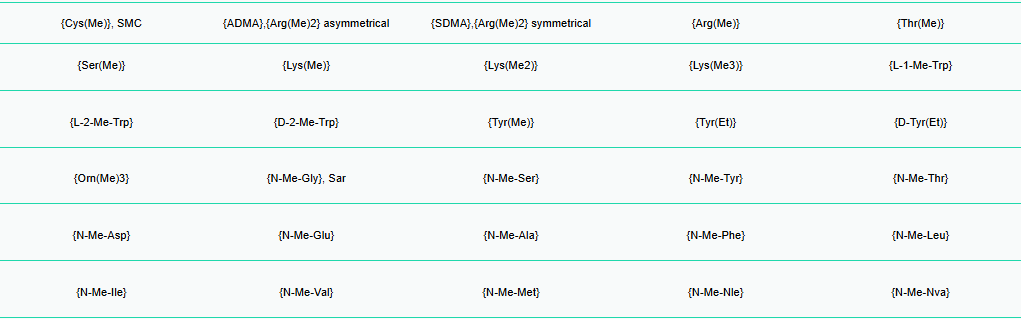
N-methyl amino acid
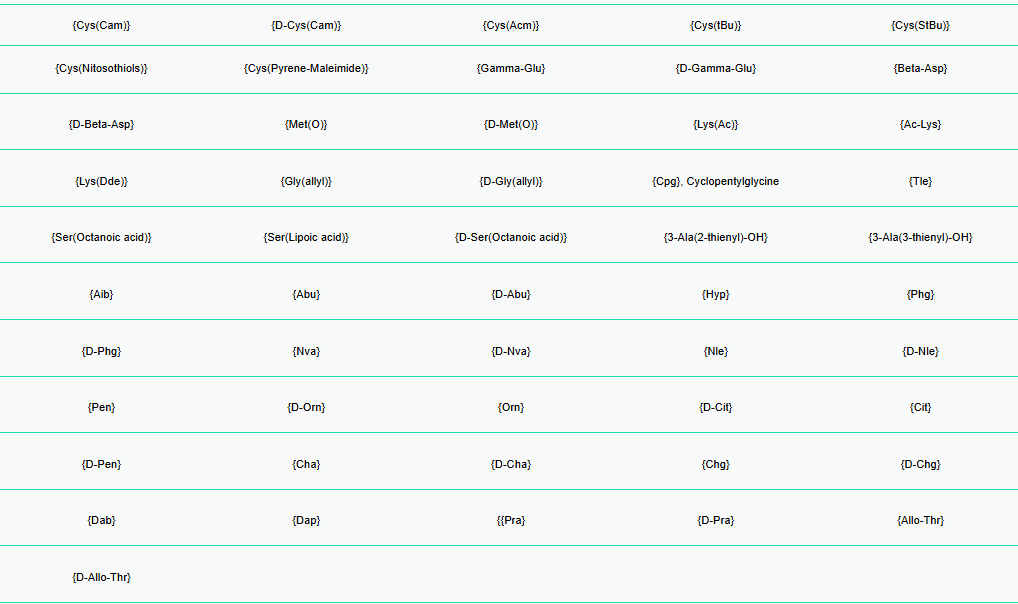
other special amino acids
Post time: 2026-08-31