
caglitide (Cagrilintide) is a new long-acting lipidated amylin analog developed by Novo Nordisk. Caglitide is composed of 37 amino acids, the C- terminal is amide type, and the α-amino group at the N-terminal is connected to 1 γ Glu and 1 eicosanedioic acid (C20diacid), and its amino acid sequence is C20 (cycl2-7). By activating specific receptors located in the medulla oblongata and hypothalamus, amylin produces satiety, while inhibiting postprandial glucagon secretion and delaying gastric emptying in non-hypoglycemic states, helping to regulate blood glucose homeostasis. Therefore, the development and optimization of amylin analogs for weight management and diabetes treatment has great potential. According to a 68-week phase I clinical trial report, the CagriSema weight loss effect of canaglitide and selmegraglutide can reach 22.7%, and it has shown good safety and tolerability. At present, there are few reports on the preparation process of canagliptide, and there is only one patent synthesis process. Only production processes employing conventional solid-phase synthesis methods have been reported.
At present, methods for preparing long peptides mainly use gene recombination and chemical synthesis. Since the C- terminal of the polypeptide obtained by the gene recombination method is carboxyl, it is necessary to add a Gly to the C- terminal, and then use peptidylglycine a amidation monooxygenase (peptidyl-glycinealpha-amidating monooxygenase,PAM) to hydrolyze Gly to achieve C- terminal amidation. Because of the high cost of PAM, the synthesis of C- terminal amide type polypeptide mainly adopts solid phase synthesis method. In the past, 1-hydroxybenzotriazole/N,N "-diisopropylcarbodiimide was usually used as a condensing agent for the synthesis of similar polypeptides, but this study intends to use 2-oxime cyanoacetate (Oxyma), which has lower explosion risk, fewer racemization side reactions and better coupling efficiency. In this paper, RinkAmide AM resin was used as solid phase carrier, Oxyma and DIC were used as condensation reagents, Fmoc protected amino acids were coupled to the resin in turn to obtain canaglide resin peptide, which was cleaved by trifluoroacetic acid to obtain crude reduced canaglide peptide, which was then cyclized, separated, purified and lyophilized to obtain high purity canaglide.
The research system explores and optimizes the relevant preparation process parameters, which can be used for kaglites. industrial production to provide reference.
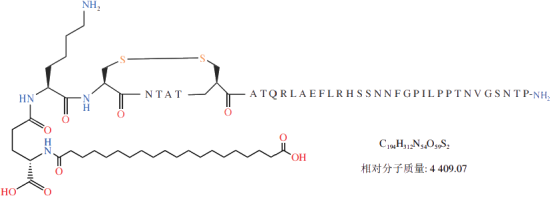
Chemical structural formula of canagliptide
basic information
chinese Name: Cagliptide
english Name: Cagrilintide
company No: GT-F064
CAS no:1415456-99-3
sequence: C20 (cycl 2-7)
molecular formula: C194H312N54O59S2
molecular weight:4409.1
Synthesis Method
1.Resin Swelling 1.0 g (0.28 mmol) of Rink Amide AM resin with a substitution degree of 0.28 mmol/g was placed into the reactor of a peptide synthesizer. 15 mL of DMF was added, and the mixture was stirred for 60 min to fully swell the resin. Nitrogen gas was purged to remove the solution, and the residue was washed twice with 10 mL DMF (2 min each time).
2.Fmoc Deprotection 10 mL of 20% piperidine in DMF solution was added to the swollen resin and stirred twice for 15 min each, followed by filtration. The residue was washed twice with 10 mL DMF, twice with 10 mL methanol, and another twice with 10 mL DMF. A small amount of resin was sampled, mixed with 40 μL of ninhydrin reagent A and 40 μL of reagent B, and heated in a boiling water bath for 5 min to assess Fmoc removal. A purple-black resin colour indicates complete deprotection.
3.Amino Acid Coupling 189 mg (0.56 mmol, 2 eq) Fmoc-Pro-OH, 120 mg (0.84 mmol, 3 eq) Oxyma and 106 mg (0.84 mmol, 3 eq) DIC were dissolved in 10 mL DMF and pre-activated for 30 min. The mixture was transferred into the reactor and reacted under nitrogen protection. Ninhydrin colourimetric assay was performed every 1 h. Colourless or pale yellow resin confirms complete coupling; otherwise, the reaction was continued.
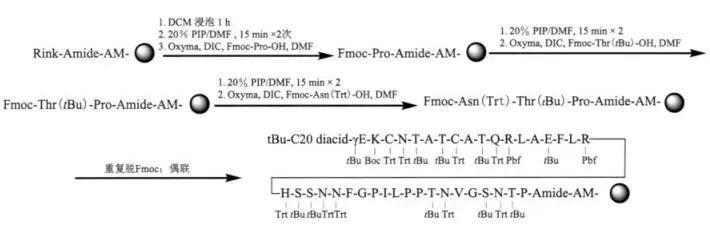
4.Coupling of Remaining Amino Acids After coupling completion, the mother liquor was removed by filtration. The resin was washed once with 10 mL DMF, twice with 10 mL methanol, and twice with 10 mL DMF. Amino acids were coupled sequentially from the C-terminus to the N-terminus according to the Cagrilintide sequence by repeating the operations described in Section 2 and Section 3 until all amino acids were coupled. The resin was then washed alternately with 10 mL DCM and 10 mL methanol for 3–6 times and dried under reduced pressure for 24 h to yield 3220 mg of yellow resin-bound peptide. The solid-phase synthesis route is shown in the attached figure.
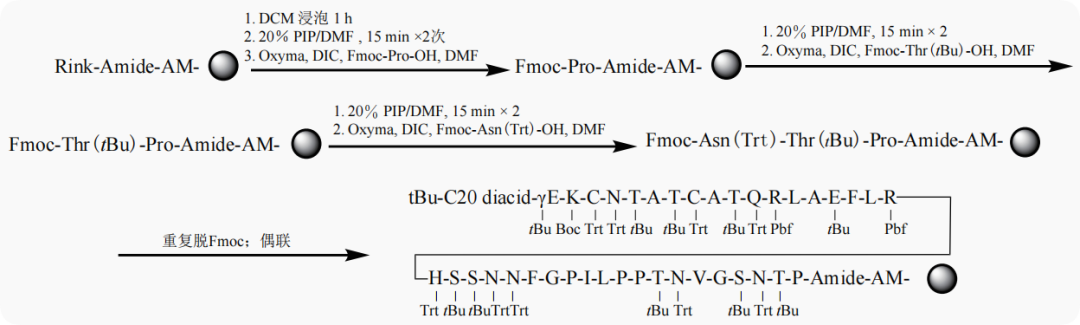
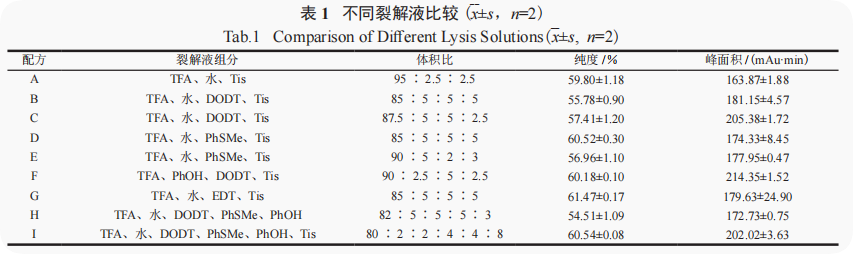
5.Cleavage of Resin-Bound Peptide and Process Optimisation During acid cleavage, various by-products are generated alongside the target product. Scavengers are generally added to the cleavage cocktail to trap carbocations. Based on the amino acid composition and side-chain protecting groups adopted in this synthesis, phenol, water, TIS, PhSMe, EDT and DODT were selected as scavengers. Phenol captures tBu groups and readily reacts with oxidants; water removes tBu and Boc groups; TIS reduces sensitive groups such as disulfide bonds during cleavage; PhSMe facilitates Trt and Pbf removal and suppresses cysteine side-chain oxidation; EDT also scavenges tBu groups and reduces cysteine oxidation; DODT is an alternative to EDT with less foul odour.
Cleavage Cocktail Optimisation
Cleavage method: Each group of cleavage cocktails (200 μL) was prepared as listed in Table 1 and reacted with 20 mg resin-bound peptide at 20 °C for 2 h. 1.6 mL diethyl ether was added for precipitation, followed by centrifugation at 9660×g for 5 min. The precipitate was washed with diethyl ether three times, dried, dissolved in 1 mL water, and filtered through a 0.22 μm aqueous PES membrane filter for HPLC analysis. Chromatographic conditions: YMC C4 analytical column (4.6 mm × 250 mm, 5 μm); mobile phase A: 0.05% TFA in water; mobile phase B: 0.05% TFA in acetonitrile; gradient elution (0–5 min, B 25%; 5–25 min, B 25%–65%); detection wavelength 215 nm; flow rate 1 mL/min; column temperature 45 °C; injection volume 10 μL. The results are summarised in Table 1. Formula F has a simple composition and provides a large peak area of reduced Cagrilintide after cleavage.
Cleavage Time Optimisation
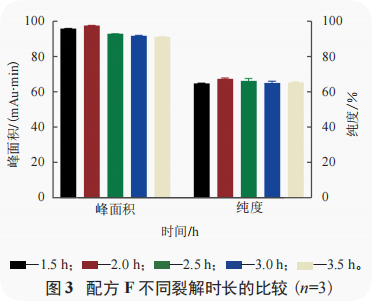
Increasing reaction time generally improves yield, yet prolonged reaction elevates the risk of side reactions, so an optimal duration must be determined. Using Formula F cleavage cocktail, sampling and detection were carried out at 1.5, 2.0, 2.5, 3.0 and 3.5 h following the procedure in Section 2.2.1 for cleavage time optimisation. The results are shown in the attached plot. The highest main peak purity and peak area of reduced Cagrilintide were obtained at 2.0 h, which was selected as the optimal cleavage time.
Cleavage Temperature Optimisation
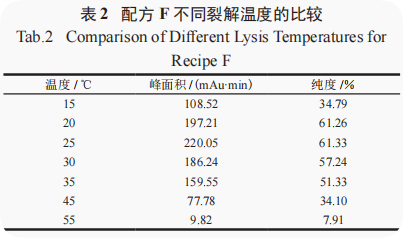
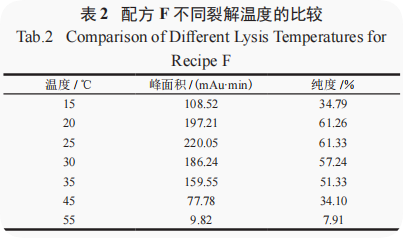
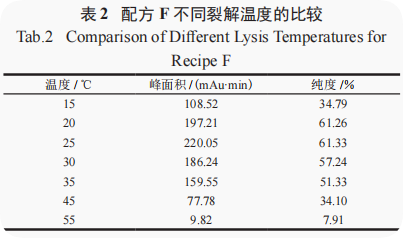
Cleavage temperature exerts a pronounced effect on the reaction. Low temperature reduces cleavage efficiency while high temperature impairs peptide stability; hence temperature optimisation was performed. Cleavage experiments were conducted at temperatures listed in Table 2 using Formula F cocktail for 2.0 h with other parameters consistent with Section 2.2.1. As shown in Table 2, reaction at 25 °C afforded Cagrilintide with superior main peak purity and peak area. Therefore, 25 °C was adopted as the cleavage temperature for subsequent tests.
Summary
In summary, the optimised cleavage process is described as follows: 1.0 g dried resin-bound peptide was mixed with 10 mL cleavage cocktail composed of TFA, phenol, DODT and TIS (volume ratio 90:2.5:5:2.5), and stirred at 25 °C for 2 h. The reaction mixture was filtered through a sand-core funnel. The filtrate was added dropwise into 80 mL cold diethyl ether (-20 °C), stirred for 5 min and kept standing at -20 °C for 30 min, followed by centrifugation. The supernatant was discarded, and the white precipitate was washed 3–6 times with diethyl ether and dried under reduced pressure. 325 mg white solid crude reduced peptide 1 was obtained. The synthetic yield was calculated as 38.56% according to Equation ①: Synthetic yield = (actual crude peptide mass × content / theoretical crude peptide mass) × 100% ① Content = (peak area of crude peptide / injection volume) / (peak area of reference standard / injection volume)
This study adopted the Fmoc solid-phase peptide synthesis strategy with Rink Amide AM resin as the solid support. A 2-fold amino acid excess and Oxyma/DIC coupling system were used for solid-phase assembly. Cleavage was performed using TFA/phenol/DODT/TIS cocktail (90:2.5:5:2.5, v/v) at 25 °C for 2 h to yield reduced Cagrilintide. After iodine-mediated oxidation for 0.5 h, one-step reversed-phase HPLC purification was performed on a C₄-30 nm preparative column using mobile phase consisting of acetic acid, water and acetonitrile. The overall route yield reached 26.14% with HPLC purity of 98.00%.
This work investigates the preparation process of Cagrilintide, aiming to improve reaction yield and reduce process complexity, thereby providing references for its industrial production. In further research, cell-based and in vivo activity evaluation will be carried out on the self-prepared Cagrilintide. Moreover, synthetic strategies such as dipeptide building blocks and combined solid-/liquid-phase synthesis will be explored to identify the optimal manufacturing route.
Post time: 2026-09-19